脱口秀大会
China’s top pork-producing province rolls out homegrown 'gene chip' for breeding quality pigs_我的网站

A |
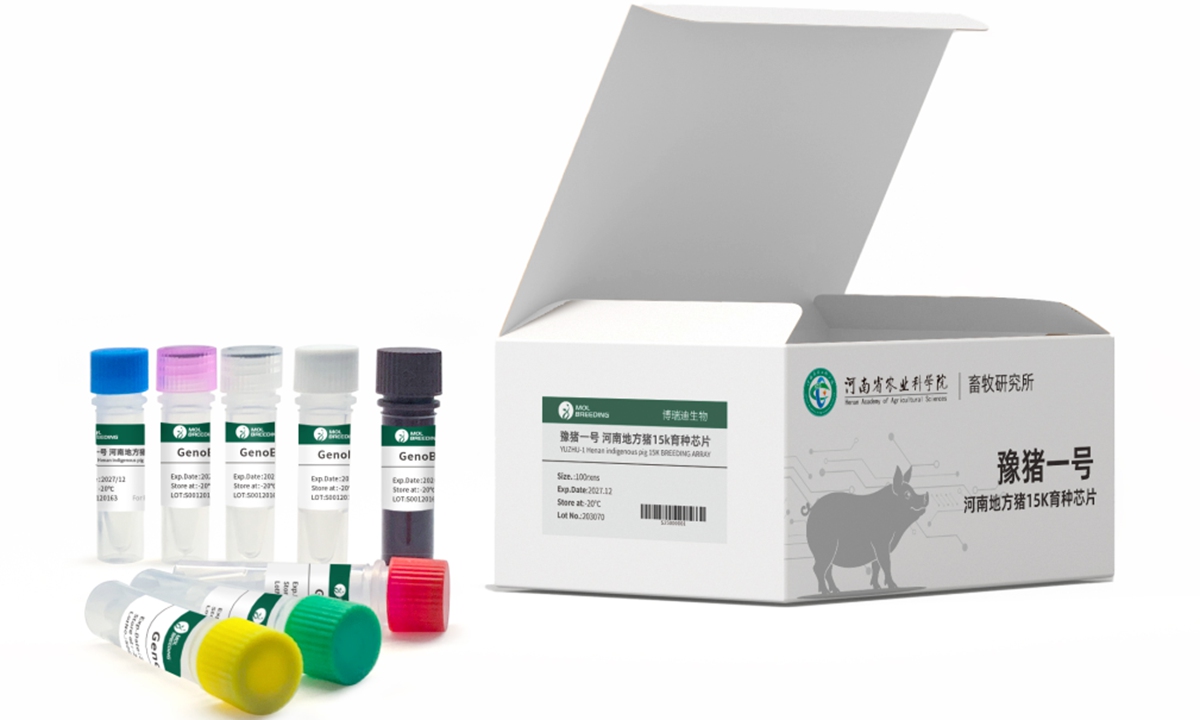
China's largest pork-producing province has introduced a genomic breeding tool designed for indigenous pig breeding, a sign that the province is shifting from expanding volume toward improving hog quality.
The Henan Academy of Agricultural Sciences announced the launch of Yuzhu-1 Henan indigenous pig 15k breeding array - commonly known as a gene chip - developed by the pig breeding team at its Institute of Animal Husbandry and Veterinary Science. It is the first such tool customized for the province's native pig stock, the institute said on Monday.
Henan is home to multiple native pig breeds prized by consumers for their good flavor. However, they carry a commercial burden compared with imported lean-meat breeds, as they grow more slowly, consume more feed per kilogram of weight gain and deliver thinner margins, noted Xing Baosong, head of the pig research office at the institute.
Lifting those hurdles depends on sharper selection, which in local herds has long relied on visual assessment of physical traits, which is slow and imprecise. Genomic tools can speed things up, but mainstream commercial chips were built on imported breeds and lose accuracy on native Chinese stock. Yuzhu No 1 instead draws on whole-genome resequencing data from five of Henan's native pig breeds and two locally bred lines.
"In breeding we rely on estimated breeding values to judge an animal's genetic potential," Wang Ligang, a professor at the Institute of Animal Sciences under the Chinese Academy of Agricultural Sciences, told the Global Times on Monday. "An array matched to the breed makes that estimate more accurate. Previously there was a real chance we were selecting the wrong animals. Now we are far more likely to be selecting the right ones - and to select accurately for the traits a breed is known for, whether that is tender meat or high fertility."
The efficiency gap between native and imported pig breeds remains wide, said Wang, who is also with the Pig Branch of the Chinese Association of Animal Science and Veterinary Medicine. Feed conversion ratios for local Chinese pigs run around 3.0, against below 2.5 for imported breeds, while reaching 100 kilograms takes native pigs 180 to 190 days compared with 130 to 140 days for exotic lines, he said.
Despite this, China's native pig breeds have their advantages.
"Our pigs taste better, partly because they are raised longer," Wang said. "And they are far more robust. Exotic breeds can suffer heat stress and die in summer; when disease hits, they can go down in large numbers. Local pigs rarely do. They tend to recover. Some breeds in Northeast China can even tolerate severe cold."
He added that imported breeds drive efficiency, while native breeds ensure quality and offer a reservoir of genetic diversity for disease and stress resistance - traits that can be bred back into commercial lines.
The province slaughtered 64.74 million pigs in 2025, up 7.4 percent year on year, with pork output at 5.22 million tons, according to the provincial statistics bureau, making it the top pork and pig producer nationwide, according to industry statistics.
In the first half of 2026, pig slaughter in the province rose a further 6.4 percent, accelerating 5.3 percentage points from the first quarter, against national growth of 1.7 percent. Xing said that more high-quality local black pigs will reach the market as Yuzhu No 1 is applied more broadly.
Other major pig production provinces such as Southwest China's Sichuan, Northwest China's Shaanxi and South China's Yunnan have all developed their own arrays.
"Provinces with the most developed pig production are the ones pushing upmarket," Wang said. "Scale is no longer the only measure. If every province reaches this level, a pattern of one dedicated array per province could gradually take shape for China's native breeds."
。

B | 7月20日,2026世界人工智能大会暨人工智能全球治理高级别会议在上海闭幕,这场为期四天的大会,已不再仅仅是一场前沿科技的“秀场”,更演变为了全球AI规则制定与地缘政治交锋的核心阵地。

C | 当中国AI产业面对严苛的外部出口管制,外媒的聚光灯究竟对准了哪里?本期节目,我们将透过《纽约时报》、路透社、半岛电视台等外国主流媒体的报道视角,还原一个在国际视野中真实崛起的中国AI生态。我们将为你拆解突破封锁的底层硬件架构创新,复盘月之暗面Kimi K3大模型“开源且廉价”的策略对海外资本市场带来的巨大冲击,并深入探讨首个落户上海的“世界人工智能合作组织”(WAICO)将如何重塑全球南方国家的数字未来。 此外,本期节目还特别汇集了理查德·萨顿、姚期智、约书亚·本吉奥、朱松纯等国内外顶尖学者在大会上的巅峰思想交锋。当机器开始主动思考,人类何去何从?“无脑堆算力就能实现通用人工智能(AGI)”是否只是一场资本的营销?在AI全面超越人类部分技能的明天,我们又该如何守住人类不可替代的“社会智能”与核心竞争力? -主播- 张无为 -时间轴- 02:20 中国AI硬件与应用的“工业化时刻” 06:40 外媒视角的撕裂——“技术陷阱”的指控与“普惠福音”的拥抱 13:05 WAICO——全球AI治理新秩序的上海坐标 16:40 顶尖大脑的思想交锋 17:05 理查德·萨顿:跨越数据枯竭,迈入“经验时代” 18:40 姚期智:AI蜕变为“主动发现者”与教育体系的重塑 20:20 朱松纯:直面差距,重塑中国AI的“原创性”与“德力” 23:50 约书亚·本吉奥:在超级智能的悬崖边构筑“护栏” 15:35 苏昊:补齐“物理智能”这缺失的一课。
Current article:http://kgh.nenyaogecebenliexi.shop/list_o4cihbk/5ttsbql.html
Published on:18:40:28
 nba
nba 盗墓笔记
盗墓笔记 不结婚
不结婚 在这世界的角落
 腾讯视频
腾讯视频 情事
情事 流星花园2
流星花园2 天地传说之鱼美人


